ADHD
How much does an ADHD evaluation cost in Los Angeles?
The cost of an ADHD evaluation depends mostly on how many hours it takes: testing, scoring, report writing and feedback. An ADHD-only evaluation usually costs less than a full evaluation that also checks learning and emotional health. Insurance may cover part of it, HSA and FSA funds often apply, and public schools evaluate for free.
How much does an ADHD evaluation cost in Los Angeles?
There is no single price. Fees for an ADHD evaluation vary a lot across Los Angeles, from one practice to the next. The biggest reason is time. A careful evaluation takes many hours of a psychologist’s work, and most of those hours happen when you are not in the room.
At MP Wellness, an ADHD evaluation for a child or teen costs $4,000, and an adult ADHD evaluation costs $1,000. Our fees and insurance page lists the fees for all of our evaluations.
When you compare quotes, compare what each fee includes, not just the total. Two evaluations with the same name can differ a lot in scope. The rest of this article explains what drives the cost, what you should expect to receive, and the ways families pay for testing.
What makes one ADHD evaluation cost more than another?
Most of the cost comes from the psychologist’s time. Here is where that time goes.
| Cost driver | What it means | Why it matters |
|---|---|---|
| Hours of testing | Face-to-face time with your child, one-on-one | More areas tested means more sessions |
| Scoring and report writing | Scoring each test, comparing results, and writing a clear report | Often takes as long as the testing itself, or longer |
| Scope | ADHD-only vs. a comprehensive evaluation | A comprehensive evaluation also checks learning, memory and emotional health |
| Rating scales | Questionnaires from parents and teachers | Collecting and scoring input from several adults takes time |
| Interviews and records | Intake meeting, review of report cards and past testing | Background matters for an accurate diagnosis |
| Feedback session | A meeting to explain results and recommendations | Longer feedback means more time with the psychologist |
| School meeting | Joining an IEP or 504 meeting | Some practices include this; others charge for it separately |
ADHD-only or comprehensive?
This is the biggest choice that affects cost. An ADHD-only evaluation focuses on attention, behavior and rating scales. It can answer a focused question well.
A comprehensive evaluation also looks at thinking skills, reading, writing, math and emotional health. That matters because anxiety, a learning disability, poor sleep and stress can all look like ADHD. Many children with ADHD also have a learning disability. A broader evaluation takes more hours, so it costs more. It can also keep you from treating the wrong problem.
Which one your child needs depends on the questions you are asking. We talk this through during the first call. If you are weighing a broader learning evaluation, see psychoeducational vs. neuropsychological evaluation.
What should the fee include?
A full ADHD evaluation should end with more than a yes or no. Before you book with anyone, ask which of these are part of the fee:
- An intake meeting with you
- All testing sessions with your child
- Rating scales for parents and teachers
- Scoring and a written report
- A feedback session to go over the results
- A school meeting, if you want one
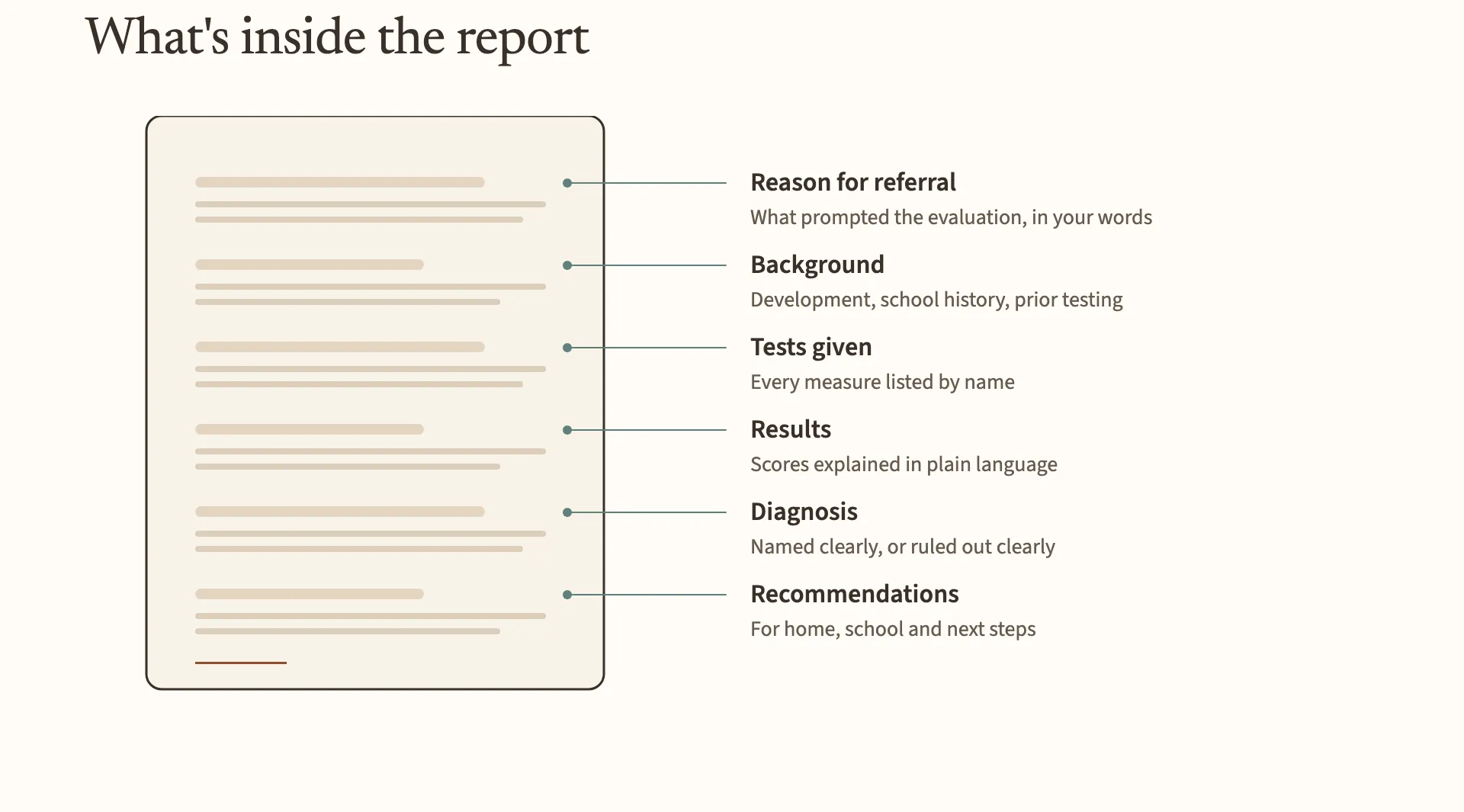
At MP Wellness, the fee includes a clinical consultation, all testing sessions, a written diagnostic report and a feedback session. If you would like us at a school or IEP meeting, that is billed separately at $250 per hour. You can read more about what we test on our ADHD testing page.
The report is where much of the value sits. It should explain your child’s scores in plain language. It should say whether ADHD fits, and if not, what better explains what you are seeing. It should also give specific recommendations you can share with your pediatrician and your child’s school.
Does insurance pay for an ADHD evaluation?
Sometimes, in part. It depends on your plan. Here are the key terms to know.
In-network vs. out-of-network. Many private psychologists, including MP Wellness, are out-of-network. That means you pay the practice directly, at the time of service. Your insurer may then pay you back for part of the cost.
Billing your insurer. Out-of-network claims need a detailed record of the dates, codes and diagnosis. Some practices hand you a receipt to submit yourself. At MP Wellness, we bill your insurance on your behalf and provide the documentation needed to support reimbursement. How much your plan pays back depends on your out-of-network benefits and deductible, and no practice can guarantee it.
CPT codes. Insurers use billing codes to describe testing. For psychological testing, the common codes are:
- 96130 and 96131: evaluation services by a psychologist, such as reviewing results, writing the report and giving feedback
- 96136 and 96137: test administration and scoring by the psychologist
You can call your insurer, give them these codes, and ask what your out-of-network benefits cover.
Prior authorization. Many plans require approval before testing starts. If you skip this step, the claim may be denied. Ask your insurer whether they need it and what forms they want.
Educational testing exclusions. Many plans do not cover testing they see as “educational,” such as testing only for a learning disability. Testing to diagnose a medical or mental health condition, like ADHD, is more often covered. Every plan is different, so ask directly.
Our fees and insurance page has more on payment and insurance billing.
Can I use HSA or FSA funds?
Often, yes. A psychological evaluation to diagnose a condition is generally an eligible medical expense. IRS Publication 502 lists fees paid to psychologists for medical care as a qualifying expense. Plans can set their own rules, so check with your plan administrator before you pay.
Can the school evaluate my child for free?
Yes. Public schools have a duty to find and evaluate children who may have a disability that affects learning. This comes from a federal law called IDEA (the Individuals with Disabilities Education Act). There is no cost to you.
To start, send a written request to your child’s school. In California, the district then has 15 days to give you an assessment plan. After you sign it, the IEP meeting must be held within 60 days, not counting school breaks longer than 5 school days. A school can also evaluate for a 504 plan, which provides classroom accommodations.
School testing has a different purpose than a private evaluation. It decides whether your child qualifies for special education or a 504 plan. It usually does not give a medical diagnosis of ADHD. Many families use both. Read school testing vs. private evaluation for a full comparison.
If you disagree with the school’s evaluation, you can ask for an independent educational evaluation (IEE) at public expense. That means an outside evaluator does the testing, and the district pays. The district must either pay for it or ask for a hearing to show its own evaluation was appropriate.
What about an adult ADHD evaluation?
Adults can be evaluated for ADHD too. The same cost drivers apply: hours of testing, scope and report writing. Adult evaluations also look back at childhood, since several ADHD symptoms must have been present before age 12. Insurance billing and HSA or FSA funds work the same way. Learn more about our adult ADHD evaluation.
Is a private ADHD evaluation worth the cost?
That depends on what you need. A private evaluation can give you a diagnosis, a detailed look at learning and emotions, and recommendations for home, school and your child’s doctor. You also choose the evaluator and when testing happens.
A school evaluation is free and focused on school support. For some families, that is enough. For others, it is a good first step. There is no wrong order.
Families across Los Angeles and the South Bay, from Redondo Beach and Manhattan Beach to Torrance and Palos Verdes, come to us with these questions. Whatever you choose, ask each evaluator what the fee includes and what you will get at the end.
When to reach out
If you are thinking about an ADHD evaluation and want to know what it would involve for your child, we are happy to talk it through. Read more about our ADHD testing, or contact us to set up a consultation.
About the author
Licensed Clinical Psychologist
- California license PSY 36605 · Verify with the state (opens the California DCA license search)
- Doctoral training in clinical psychology
- About about eight years of psychological and neuropsychological assessment experience
- Born and raised in Redondo Beach
This article is general information, not a diagnosis or medical advice. Every child is different. If you have concerns, talk with your pediatrician or a licensed psychologist.